
Europe’s freezer attacks raise a bigger question: who controls your equipment?
A refrigeration controller rarely attracts the same security attention as a payment system. Yet having its settings changed wrongly, or by a malicious actor can interrupt operations, destroy stock and create safety risks.
The recent attacks on supermarket refrigeration systems across Belgium and other European countries make said safety risk tangible. For businesses that depend on controlled environments, remote access to equipment deserves a place in the security conversation.
The financial consequences can be substantial. After the October attacks in France, Intermarché CEO Thierry Cotillard estimated nationwide losses could reach tens of millions of euros in a single day, according to Reuters. This was an early estimate, rather than a confirmed final total.
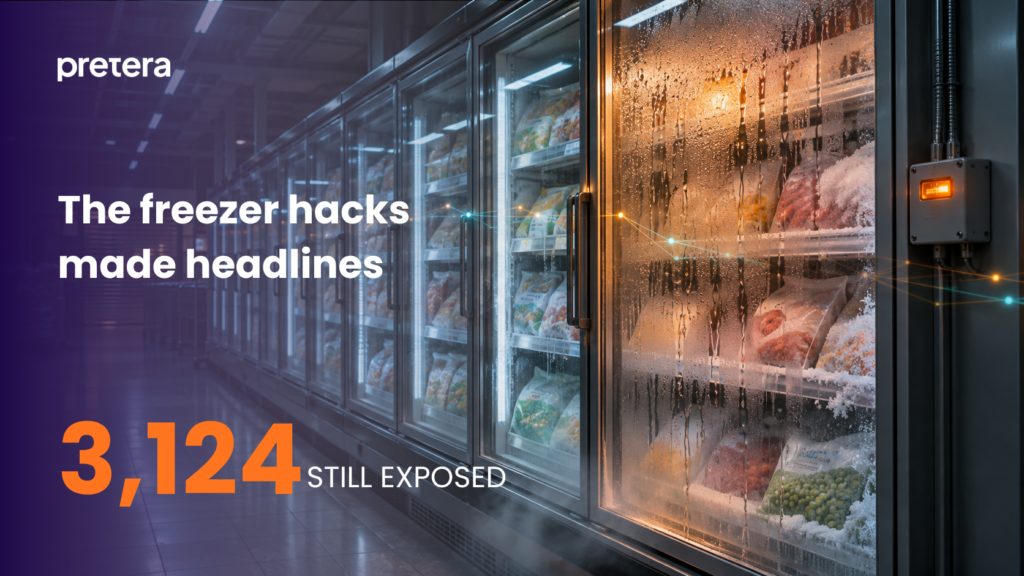
Fresh research from Censys, published on 2026-11-05, adds an important development. Across two refrigeration-controller product families, observed internet exposure fell from 6,695 to 3,124 distinct hosts between 2026-10-09 and 2026-11-05, a 53% reduction.
That is encouraging, but thousands remained visible. An exposed controller is not necessarily compromised, and those figures do not establish how any particular victim was breached. They do give organizations a reason to examine their own installations.
Who has access to your cold room?
Remote maintenance helps businesses keep equipment running. The practical question is whether that access, and the potential risk attached to it is understood, restricted and tested.
For retailers, warehouses and other operators in Belgium, a useful starting point is to ask:
- Which operational systems can be reached from outside our network?
- Who maintains that access, including contractors and equipment suppliers?
- What settings can a remote account change?
- Would we detect an unauthorized change quickly enough to act?
- What is the business/operational impact?
These questions cross departmental boundaries. IT, facilities teams and maintenance providers may each understand only part of the system. Bringing those views together can reveal access that no single team realized it owned.
Find the weakness before it affects operations
For businesses that rely on controlled devices, crucial for their business (i.e. refrigeration), a security assessment should connect technical access to operational consequences. Could an unauthorized user reach a controller? What could they change? Which safeguards would limit the impact?
At Pretera, we approach security from the attacker’s perspective: where could we get in, what could we reach, and what could we change? For connected/remotely controlled systems, that means looking beyond a login screen to understand whether an access point could become a path to operational disruption. Our offensive security approach helps businesses test those paths before they’re attacked.
Pretera’s OT penetration testing services has been helping organizations investigate these risks through assessments scoped around operational constraints. The aim is to identify weaknesses and prioritize practical improvements while accounting for the environment’s sensitivity.
Remote access keeps your equipment running. In the wrong hands, it can disrupt your operations. Talk to Pretera about who can access your systems, what they can do, and how to prevent misuse.